
Between 1990 to 1992, President George Bush laid out his vision of the New World Order in speeches at the United Nations. When he said it was a Big Idea, that was without doubt, the understatement of the millenia. In the 1991 speech, he said the idea wasn’t Pax Americana, it was Pax Universalis. Unpacked, that term meant, a One World Order under the United Nations System. He added meat to the idea in his 1992 UN Speech by defining the conceptual changes to the world organization, the synopsis of which was a shift away from nation-state organization to a free market economic order within regional systems. He proposed preventative peacekeeping, making our military bases open for other militaries to use and for our military to become involved in crisis management. He said our government needed to be restructured for the new mission of one world (not in those words). Bush ran out of time in office to initiate the restructuring. When Bill Clinton and Al Gore came into office, they went full into the restructuring our government by initiating the President’s Council on Sustainable Development. Commerce Secretary Ron Brown led the Council.
On May 2, 1990, Senator Claiborne Pell placed into the Congressional Record a copy of an article on America’s Role in the World written by Senator David Boren. The article was published in the Washington Post.
June 17, 1990, President George Bush, Remarks announcing the Enterprise for the Americas initiative.
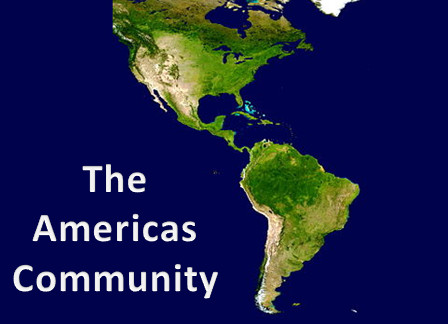
. . . we must build on the trend we see toward free markets and make our ultimate aim a free trade system that links all of the Americas: North, Central, and South. And we look forward to the day when not only are the Americas the first fully free, democratic hemisphere but when all are equal partners in a free trade zone stretching from the port of Anchorage to the Tierra del Fuego.
Regional Economic Order
1990
President George H.W. Bush, 1990
October 1, 1990, Address Before the 45th Session of the United Nations General Assembly in New York, New York
https://www.c-span.org/program/white-house-event/presidential-speech/130406
Text of President Bush’s UN speech:
https://www.presidency.ucsb.edu/node/264816
End of the Cold War, beginning of open borders, open trade
1945 – A new kind of bridge (UN), Revolution of 1989, two days from now in Berlin cold war will be buried, new partnership of nations, annexation of Kuwait will not be allowed to stand. Iraq against the world. In Iraq at the request of the Saudi Kingdom. Chemical weapons ban. Turn of the millennium. Open borders, open trade, open minds. The Americas can provide a model for the world. North, Central and South. Model of European Unity.
This is a new and different world. Not since 1945 have we seen the real possibility of using the United Nations as it was designed: as a center for international collective security.
Free elections are the foundation of democratic government and can produce dramatic successes, as we have seen in Namibia and Nicaragua. And the time has come to structure the U.N. role in such efforts more formally. And so, today I propose that the U.N. establish a Special Coordinator for Electoral Assistance, to be assisted by a U.N. Electoral Commission comprised of distinguished experts from around the world.
The U.N. is now fulfilling its promise as the world’s parliament of peace.
1991
President George H.W. Bush, 1991
September 23, 1991, Address Before the 46th Session of the United Nations General Assembly in New York, New York
https://www.c-span.org/program/white-house-event/united-nations-speech/175477
Text of President Bush’s UN speech:
https://www.presidency.ucsb.edu/node/266506
Pax Universalis, resumption of history.
1975 – resolution equating zionism with racism. UN promoting economic and social advancement of all people. Free flow of goods and ideas. Information revolution. Free markets. GATT. Uruguay Round. Soviet coup plotters – August. Soviet Union and US opposing Saddam Hussein. Kuwait. Model for collective settlement of disputes. Can’t guarantee borders. UN Res. 3379, PAX Universalis. George H.W. Bush, Role of the United Nations in the Post-Cold War Era, accompanied by Lawrence Eagleburger, Brent Scowcroft and Edward Perkins, US delegate to the UN. Free market economic order. Global defense conversion. Disaster assistance. Build a stronger world economy.
Finally, you may wonder about America’s role in the new world that I have described. Let me assure you, the United States has no intention of striving for a Pax Americana. However, we will remain engaged. We will not retreat and pull back into isolationism. We will offer friendship and leadership. And in short, we seek a Pax Universalis built upon shared responsibilities and aspirations.
Referred to in his speech:
Joint Resolution of Congress
Public Law 102-14, March 20, 1991, designating Education Day, U.S.A. Noahide Laws, tribute to Rabbi Schneerson and Jewish morality
https://www.congress.gov/102/statute/STATUTE-105/STATUTE-105-Pg44.pdf
Presidential Proclamation 6262, March 20, 1991. Proclamation 6262—Education Day, U.S.A., 1991
https://www.presidency.ucsb.edu/node/268448
“The worldwide Lubavitch movement, under the leadership of Rabbi Menachem Schneerson, has underscored the importance of moral education, as well as the primary role of parents and religious institutions in promoting high standards of personal character and conduct in our society.”
1992
1992 – Naval War College, Newport, RI, original paper: Strategy and Campaign Report, 12-91
Toward a Pax Universalis: A Historical Critique of the National Military Strategy for the 1990s
The centerpiece of the new U.S. strategy for the “New World Order” is strategic reserve called the Crisis Response Force [Side note: See Global Systems: GEMINI – 1995]
The historic models chosen are the early Roman Empire (from the fall of Carthage to A.D. 69; middle Roman Empire from A.D. 69 to A.D. 306; late Roman Empire from A.D. 306 until the internal collapse in A.D. 476); the Byzantine Empire from A.D. 527 to A.D. 1000 the British Empire from Waterloo to World War I.
The study concludes that, as a (possibly extended) transitional stage toward an ideal network of regional coalitions, the new national strategy is realistic and effective-except, significantly. in the Middle East where a “naval bridge” approach should taken.
President George H.W. Bush, 1992
September 21, 1992, UN Speech
https://www.c-span.org/program/white-house-event/role-of-united-nations-in-post-cold-war-era/24849
text: Address to the United Nations General Assembly in New York City
https://www.presidency.ucsb.edu/node/267788
And third, we face the common economic challenge of promoting prosperity for all, of strengthening an open, growth-oriented free market international economic order while safeguarding the environment.
We too must change our institutions and our practices if we are to make a new world of the promise of today, if we’re to secure a 21st century peace.
I believe the international community can work together to meet these three challenges and how the United States is changing its institutions and policies to catalyze this effort.
The need for monitoring and preventive peacekeeping, putting people on the ground before the fighting starts, may become especially critical in volatile regions.
Effective multinational action will also require coordinated command-and-control and interoperability of both equipment and communications. Multinational planning, training, field exercises will be needed. These efforts should link up with regional organizations.
Four, we will need to develop planning, crisis management, and intelligence capabilities for peacekeeping and humanitarian operations.
I have directed the United States Secretary of Defense to place a new emphasis on peacekeeping. Because of peacekeeping’s growing importance as a mission for the United States military, we will emphasize training of combat, engineering, and logistical units for the full range of peacekeeping and humanitarian activities.
We will work with the United Nations to best employ our considerable lift, logistics, communications, and intelligence capabilities to support peacekeeping operations.
I have further directed the establishment of a permanent peacekeeping curriculum in U.S. military schools. Training plainly is key. The United States is prepared to make available our bases and facilities for multinational training and field exercises.
I stated yesterday, during a moment of international uncertainty, that the United States would be strongly engaged with its global partners in building a global economic, financial, and trading structure for this new era. At the same time I urge that our global responsibilities lead us to examine ways to strengthen the G – 7 coordination process. I affirmed America’s support for European integration that opens markets and enhances Europe’s capability to be our partner in the great challenges that we face in this new era.
To ensure that the benefits of this growth are sustained and shared by all, fair and open competition should be the fuel for the global economic engine. That’s why the United States wants to complete the Uruguay round of the GATT negotiations as soon as possible and to create a network of free trade agreements beginning with the North American free trade agreement. At the same time we need to recognize that we have a shared responsibility to foster and support the free market reforms necessary to build growing economies and vibrant democracies in the developing world and in the new democratic states. This should be done by promoting the private sector to build these new economies, not by fostering dependency with traditional government-to-government foreign aid.
. . . foreign aid as we’ve known it needs to be transformed. The notion of the handout to less developed countries needs to give way to cooperation in mutually productive economic relationships. We know that the more a nation relies on the private sector and free markets, the higher its rate of growth; the more open to trade, the higher its rate of growth; and the better a country’s investment climate, the higher its rate of growth.
To move from aid, what I would call aid dependency, to economic partnership, we propose to alter fundamentally the focus of U.S. assistance programs to building strong, independent economies that can become contributors to a healthy, growing global economy. Now, that means that our new emphasis should be on building economic partnerships among our private sectors that will promote prosperity at home and abroad also.
Working with our Congress, I will propose a top-to-bottom overhaul of our institutions that plan and administer foreign assistance, drastically reducing the bureaucracy that has built up around Government-based programs; streamlining our delivery systems; and strengthening support for private sector development and economic reform. The Agency for International Development, AID, another institution born during the cold war, needs to be fundamentally and radically overhauled. Promoting economic security, opportunity, and competitiveness will become a primary mission of the State Department.
Our assistance efforts should not be charity. On the contrary, they should promote mutual prosperity. Therefore, using existing foreign affairs resources, I will propose creating a $1 billion growth fund. The fund will provide grants and credits to support U.S. businesses in providing expertise, goods, and services desperately needed in countries undertaking economic restructuring.
State of the Union – January 31, 1990 – enterprise zones, health care studies, mail bombs
https://www.c-span.org/program/american-history-tv/1990-state-of-the-union-address/130401
Text: https://www.presidency.ucsb.edu/node/263819
State of the Union – January 29, 1991, Prince Bandar, New World Order, Community of Nations,
https://www.c-span.org/program/the-presidency/1991-state-of-the-union-address/11001
Text: https://www.presidency.ucsb.edu/node/265956
State of the Union – January 28, 1992
https://www.c-span.org/program/american-history-tv/1992-state-of-the-union-address/17329
Text: https://www.presidency.ucsb.edu/node/266921
Remarks on Signing the North American Free Trade Agreement, December 17, 1992, OAS
https://www.c-span.org/program/white-house-event/north-american-free-trade-agreement/28115
Text: https://www.presidency.ucsb.edu/node/267947
Knowledge Management: Insights from Global 2001, War Games
https://thetechnocratictyranny.com/PDFS/Knowledge_Management_2002.pdf



One Comment
Kristin
“And in short, we seek a Pax Universalis built upon shared responsibilities and aspirations.” Makes me sick the hubris. “Localization of global affairs” is required reading and my favorite of yours so far. I’m interested in what this current Trump administration will go considering he gives appearance of anti-UNism.