On January 25, 1993, Clinton’s new Secretary of State, Warren Christopher addressed the employees of the State Department. His message was that given the Cold War was over and the Soviet Union was no longer a threat, they would be formulating a new foreign policy. He introduced his Deputy Secretary Clifton R. Wharton who was to be responsible for the restructuring of the Department for the new mission.
The stunning part of the message was that their foreign policy would also become domestic policy. He even mentioned an America’s Desk.
An early archived copy of the State Department website was found. This is a link to the 1997 archive. They did in fact set up an America’s Desk.
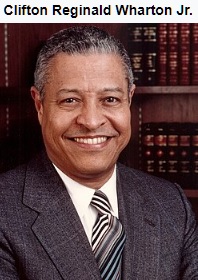 Clifton Wharton, Deputy Secretary of State was appointed to a task force to re-examine and restructure the State Department to meet the new challenges. It should be noted that Wharton did not have a background in foreign policy. He had been Chairman of the Rockefeller Foundation, President of the Michigan University, Chancellor State University of New York (SUNY) and CEO of TIAA-CREF – Teachers Insurance and Annuity Association of America and College Retirement Equities Fund. CREF – College Professors and supporting staff. Wharton’s tenure at the State Department: January 27, 1993 – November 8, 1993. Strobe Talbott was appointed to replace Wharton. Video times, 12:00 minutes, 13 minutes, 19:14 minutes

Global Affairs – New Agency for Localization
On July 21, 1993, Deputy Secretary of State, Tim Wirth held a meeting with State Department employees to announce a new Office of Global Affairs and a new mission for the State Department. The new mission was localization of global initiatives. They were told they would have to go out and find their own constituencies. The initiatives for which the reorganization was being done:
- Democracy & Human Rights
- Population – reduction
- Environment
- Sustainable Development
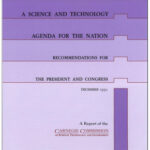
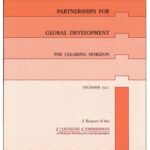

In the remarks of Tim Wirth to State Department employees, he mentioned the Carnegie Report on the transition of the presidency. The transition report mentions the Global Development Report which corresponds to the new post Cold War agenda talked about by Wirth.
Tim Wirth’s entire career had been within our domestic political system. He was a White House Fellow during the Johnson Administration. Deputy Secretary of Education during the Clinton Administration. He was elected to be a member of the House of Representatives from of Colorado (1975-1987); Senator from Colorado (1987-1993). In 1993, Wirth was appointed by Secretary of State Warren Christopher to the State Department where he organized the new agency, Under Secretary of State for Democracy and Global Affairs (April 1993 – December 1997). His mission in the State Department was Localization. Localization included restructuring of the United Nations and breaching the barriers between foreign and domestic policy. To be succinct, Bill Clinton and Tim Wirth executed a coup d’etat on the United States. Al Gore led the effort for national information systems of command and control to ensure the continuity of the coup.
The redefinition of foreign policy from cold war to localization was not a policy to serve the interests of the American people. It was a policy of subversion and they changed our form of government in the process. The bullet points for the new policy were:
Internationalization – State Department effectively becomes an agency of the United Nations – working to strengthen the UN – betraying the American people.
Localization of global affairs – nation state diplomacy replaced by missionaries for sustainable development – translated to be on-the-ground meddlers in the affairs of other nation-states and outside their bailiwick as it pertains to operations within the borders of the U.S.
Population reduction for the third world and consumption reduction for the first world – in other words, economic warfare on the American people.
Localization of Global Affairs
May 24, 1993
S.Con.Res 26 – Sponsored by Sen. Paul Simon
Section 1. Short Title.
This resolution may be cited as the “Many Neighbors, One Earth Resolution.
Section 2. Sustainable Development Policy and Program of Action
(a) In General — The President is urged to develop and implement a coordinated economic and development policy and program of action designed to promote broad-based, sustainable development.
A Brief Walk Back in History
The establishment of the Helsinki Commission began with President Richard Nixon’s détente negotiations with the Soviet Union. Nixon was forced to resign in 1974. He was replaced by Gerald Ford. In 1975, the Helsinki Final Act was signed by President Ford. Treason in Helsinki, 1975. The Helsinki Accords established what was/is a shadow government. Helsinki Accords: Shadow Government. In 1976, the Helsinki Monitoring Group comprised of human rights activists was formed. The system of non-profit monitoring groups metastasized from that point forward.
A college professor named Victor-Yves Ghebali was really the only person to document the history of the OSCE from the beginning. In the Introduction of Volume Two titled The OSCE in Post-Communist Europe: Towards a Pan-European Security Identity 1990-1996 , he wrote the following:
Adopted at the apogee of the East–West détente, the Helsinki Final Act (1975) tasked the Conference on Security and Cooperation in Europe (CSCE) with a formal mission focused on the immediate present and an implicit mission aimed at a distant future. The former was the development of diverse and in-depth cooperation between countries “irrespective of their political, economic or social systems”. The latter, conceived of from a perspective that everyone considered to be utopian, envisaged nothing less than overcoming the artificial division of Europe on the basis of Western values.
Matching Missions: Decolonization: The UN’s War on Western Civilization Willy Brandt, Socialist International, 1976. Tim Wirth and Bill Clinton, 1993.
The mission of the Helsinki agreement was the progressive collectivization of Europe. Since the United States was a signatory and with the benefit of history, we know that the United States leadership engaged in progressive collectivization of North America. Succinctly, the European Union and the North American Union. It was found that the plan for global regionalization dated by even farther than that.
Commonwealth Plan of Four or Five Territorial Bodies
In 1990, the European project for collectivization of European nations was complete. The Charter for a New Europe (aka Charter of Paris) was signed the leaders of the CSCE countries. Notice that the charter refers to both North American and European States as a fundamental characteristic of the CSCE.
In the Service of Empire . . . Notice the regional electoral map.
Post Cold War: Foreign Policy becomes a Global Con Game
Trade and Aid
“Good Partners in the Development Process”
Human Rights Agenda
United Nations – Human Rights
Office of the High Commissioner
The World Conference on Human Rights took place in Vienna, Austria from 14-25 June 1993. A pivotal moment, the conference’s main outcome was the Vienna Declaration and Programme of Action, a common plan for the strengthening of human rights work around the world.
The conference also made concrete recommendations for strengthening and harmonising the monitoring capacity of the United Nations system. It called for the establishment of the post of the High Commissioner for Human Rights by the General Assembly, which subsequently created it on 20 December 1993.
Vienna Declaration and Programme of Action, June 25, 1993
Timeline from the UN High Commissioner for Human Rights:
General Assembly resolution 45/155 decided to convene the world conference on human rights and establish the Preparatory Committee
Commission on Human Rights resolution 1991/30 (in E/1191/22, p. 78) made recommendations to human rights mechanisms and the Preparatory Committee
1991-1993 – The Preparatory Committee for the World Conference on Human Rights held 4 sessions from 1991 to 1993.
1992 President George Bush signed the International Covenant on Civil and Political Rights (ICCPR). (1966 UN adopted the ICCPR. 1977, Jimmy Carter sent it to the Senate for Advise and Consent, April 1992, the Senate gave consent and April 1992, George Bush signed it.) Source: Carter Center Website, article by Jimmy Carter .
State Department legislation, S.1856 – Peace, Prosperity, and Democracy Act of 1994
S.Con.Res.26, May 24, 1993
Urging the President to redirect United States foreign assistance policies and spending priorities toward promoting sustainable development, which reduces global hunger and poverty, protects the environment, and promotes democracy.
Whereas the easing of Cold War tensions requires a reassessment of United States foreign assistance objectives, programs, and spending priorities, and presents a unique opportunity to shift the emphasis from military and security-related priorities to addressing the urgent and interrelated problems of poverty and environmental destruction;
Whereas nongovernmental organizations, both in the United States and in developing countries, are often highly qualified actors in promoting grassroots development, strengthening civil society, and providing humanitarian assistance;
Whereas since the mid-1980s, resources have begun to shift within the foreign assistance budget toward increased expenditures for humanitarian and sustainable development programs: Now, therefore, be it (resolved . . . )
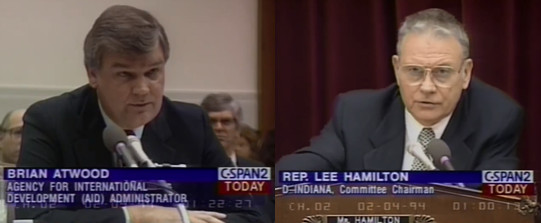 Foreign Assistance Hearing – Lee Hamilton presiding,
February 4, 1994
Warren Christopher had been the Deputy Secretary of State under the Carter Administration. Carter ordered the State Department to produce the first Human Rights Report – further, that it be produced annually.
Bill Clinton appointed Warren Christopher to be his Secretary of State. The global initiatives that Tim Wirth spoke about in his remarks to the State Department employees listed above correspond to the United Nations Vienna Declaration and to the President’s Council on Sustainable Development (PCSD). Tim Wirth was appointed to be a member of the PCSD.
Blueprint for the Reinvention of Government
PCSD Members and Task Forces
H. Rept. 109-168 – FOREIGN RELATIONS AUTHORIZATION ACT, FISCAL YEARS 2006 AND 2007
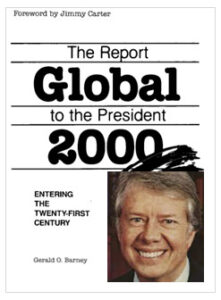
Tim Wirth also mentioned the Global 2000 report. This report was produced during Jimmy Carter’s Administration. It’s actually two volumes but the second volume is all statistics. It’s noteworthy that many of Clinton’s appointees were Carter Administration retreads.
In 1993, Gerald O. Barney who was the Director of the Global 2000 project during the Carter Administration, published an updated version of the Global 2000 report:
In the year 2000, the San Francisco Chronicle published an editorial by Barney. The article reveals the religious beliefs behind the report and the project.
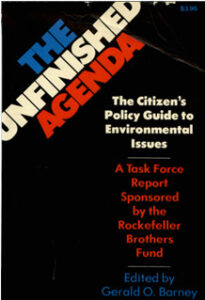
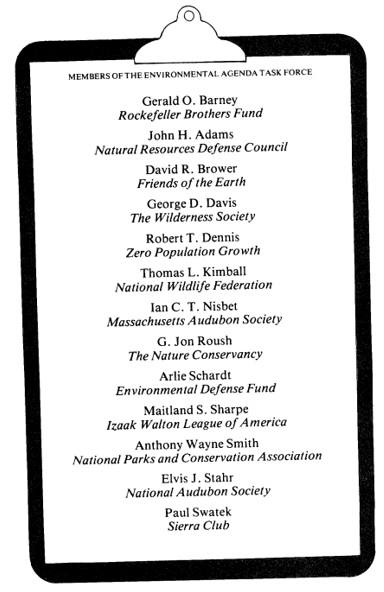
A earlier report sponsored by the Rockefeller Brothers Fund lead by Gerald O. Barney was The Unfinished Agenda. It was published in 1977.
In a press conference in 1994, Warren Christopher who at the time was employed by the State Department produced the first Human Rights report.
Notice that John Adams was a member of the Rockefeller Brothers task force. In 2010, he and his wife Patricia gave an interview about the beginnings of the Natural Resources Defense Council (NRDC). There is a recording of the interview in this article: The Charity Industrial Complex: Charity for Business